
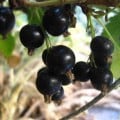
 Blackcurrant or Ribes nigrum is native to central and northern Europe and northern Asia. It is small shurb that gorws 1-2 m tall. The flowers are 4-6 mm in diameter and the fruits are edible.
Blackcurrants have very high vitamin C content along with potassium, phosphorus, iron, vitamin B5 and a range of other nutrients. They also have phytochemicals such as anthocyanins (or polyphenols). The major anthocyanins in blackcurrant pomace are delphinidin-3-O-glucoside, delphinidin-3-O-rutinoside, cyanidin-3-O-glucoside and cyanidin-3-O-rutinoside. Blackcurrant seed oil is rich in gamma-linolenic acid (GLA), an essential fatty acid, along with many other nutrients.
Laboratory experiments have shown that the anthocyanins in blackcurrant have the potential to support normal anti-inflammatory mechanisms and are beneficial for heart health, preventing free radical damage, microbial infections and neurological health.